Every post comes from something I've done on a real project. AI tools, development approaches, how I actually build things. You're getting a curation of my taste, not takes on stuff I don't use. Subscribers also get extras: things that went wrong, how my thinking about AI is changing, hacky workflows I use every day, and the occasional personal update. Stuff I share with subscribers because it's a little too personal or unpolished to blast across the internet.
building my personal writing app
|
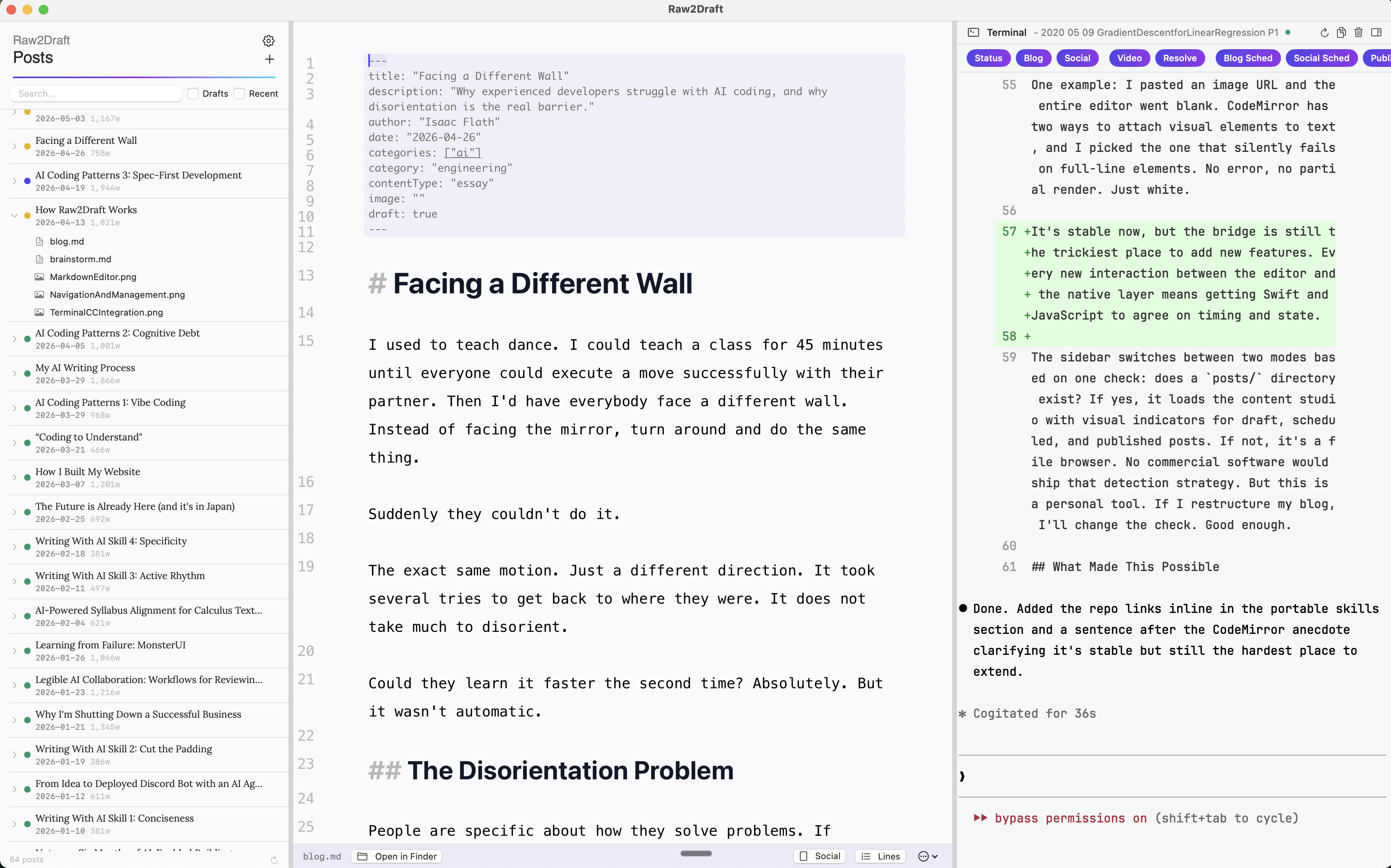
I'm open-sourcing my personal writing app, Raw2Draft. It's the first of several tools I'll be releasing over the coming months. Next is the knowledge base framework I use. Then an agent harness setup build on top of Pi (if it goes well). Personal tools have gotten cheap to build. Tools that work exactly how you think. Should you use mine? Probably not. It wasn't designed for you. But if writing is part of what you do, you should consider building your own. Point your agent at this repo (and others) and have it help you extract the parts you like. And remember to show support and acknowledgement for any open project you used! How Raw2Draft WorksI built a markdown editor called Raw2Draft. It has an embedded terminal running Claude Code, a preview pane that matches my blog’s typography, and an iA Writer-inspired styling layer. The interesting part is the agent skills that power my AI writing workflow. They’re portable: they work in Raw2Draft, in a plain terminal, and in other agents.
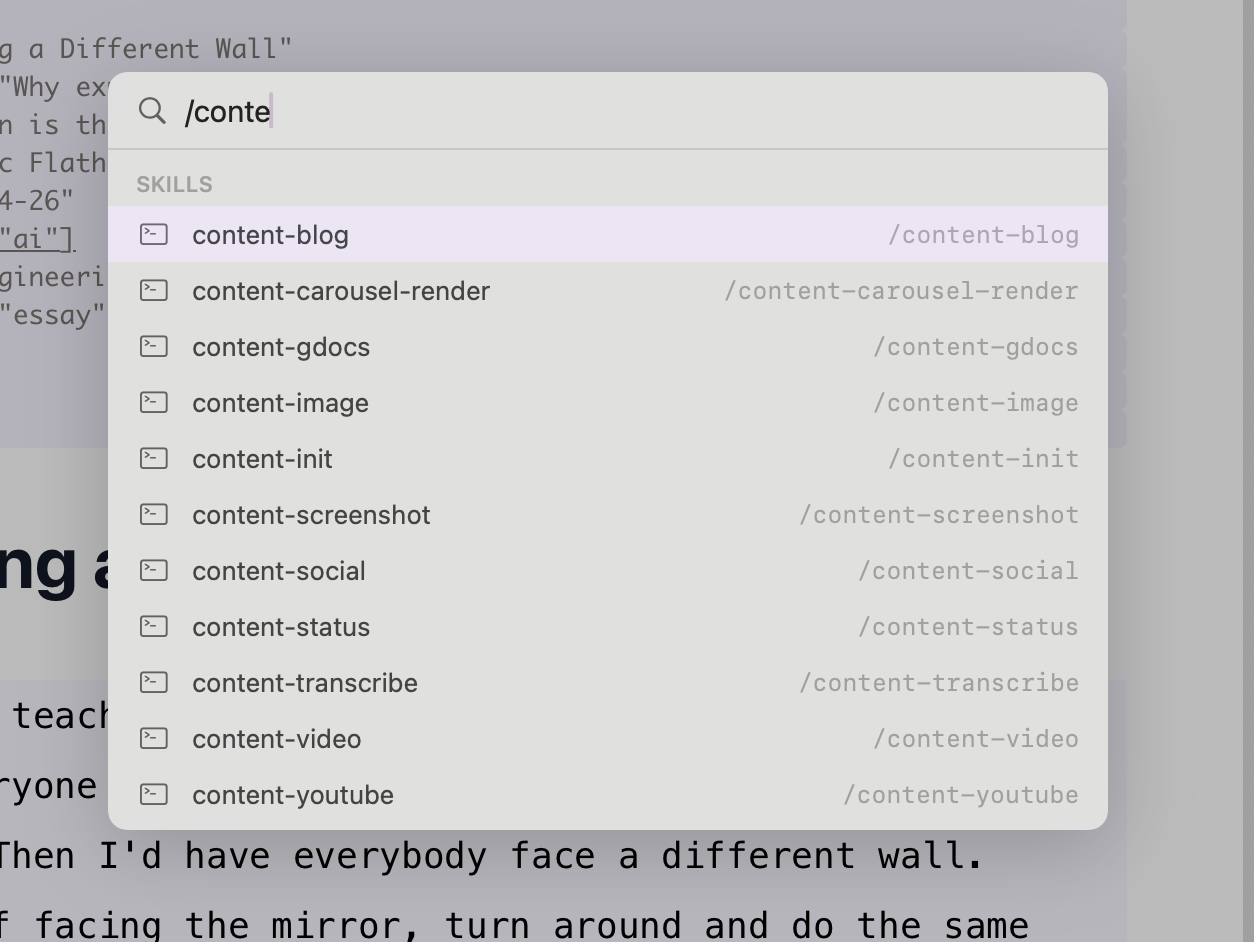
Portable SkillsThe skills that power my writing workflow are Claude Code skills: markdown files with plain English instructions. The same skill files work in Raw2Draft, in a plain terminal session, in Codex, or any other agent. If I switch editors tomorrow, the skills come with me. On first launch, Raw2Draft clones two public GitHub repos: agent-starter-skills (skills for blog writing, transcription, social media, publishing, scheduling, and video editing) and agent-starter-wiki (a knowledge base with reference docs like writing style guides). Both get passed to Claude Code as context directories via The skills are procedural: do this, then this, then this. The knowledge base is about taste and judgment: how I write, what I’ve learned about specific APIs, style decisions I’ve made. That separation keeps the skills clean. I’ll write about my personal knowledge base separately. CompositionI use a “parent skill” pattern. The same sub-skills get reused in different contexts. When I’m writing a spec, I call the screenshot skill directly. When I’m editing video, the transcription skill uses a different provider because video editing needs filler words preserved for accurate cut detection. Different parent skills compose them differently, and I compose them by hand when I need something one-off. I don’t write a script until the plain English version fails. Scripts handle Gemini calls, S3 uploads, frontmatter parsing. The decisions about what to do and when live in plain English. What a Writing Session Looks LikeA post starts as a voice transcription (my wife calls it recliner rambling) saved alongside screenshots, videos, or reference files. I call When the post is ready, Embedding Claude CodeRaw2Draft doesn’t have its own AI. It launches Claude Code as a subprocess in an embedded Ghostty terminal, passing it the project directory and a set of context directories. Claude Code provides the reasoning, file editing, and skill execution. Raw2Draft provides the writing surface and the glue between them. That glue is small. The app writes the current file path to
The TerminalThe hardest part was the terminal. I tried xterm.js (too many edge cases), then SwiftTerm (rendering bugs because Claude Code assumes a full terminal). I switched to The EditorThe markdown editor uses CodeMirror. It handles markdown well, it’s extensible, and the styling system let me build the look I wanted. The whole thing is a small JavaScript project embedded inside the native app. The native app and the editor talk through a bridge: Swift sends content in, JavaScript sends keystrokes back. That bridge has been fragile. One example: I pasted an image URL and the entire editor went blank. CodeMirror has two ways to attach visual elements to text, and I picked the one that silently fails on full-line elements. No error, no partial render. Just white. It’s stable now, but the bridge is still the trickiest place to add new features. Every new interaction between the editor and the native layer means getting Swift and JavaScript to agree on timing and state. The sidebar switches between two modes based on one check: does a What Made This PossibleI started with three separate repos: the blog, Raw2Draft, and a knowledge base. Skills and reference docs were duplicated across all of them. I consolidated into one monorepo so everything could share context. Then I built the knowledge base into its own system, and that let me decouple again. The skills and knowledge live in their own repos. Raw2Draft, the blog, and any future tool can pull from the same source. The consolidation taught me what needed to be shared. The knowledge base made sharing possible without coupling. The skill architecture means adding a new capability is writing a markdown file. When I designed a social media skill, I wrote three rules in English: find the hook, maximize white space, preserve voice. A year ago, writing instructions in a markdown file would not have been enough. Now it is. I like Raw2Draft better than any other writing tool I’ve used. Better than Google Docs. Better than Typora. Not because it’s more polished. Because it does exactly what I need, the way I need it, and nothing else. Thanks, Isaac p.s. If you were forwarded this email, all my writing is available on my website |
Isaac Flath
Every post comes from something I've done on a real project. AI tools, development approaches, how I actually build things. You're getting a curation of my taste, not takes on stuff I don't use. Subscribers also get extras: things that went wrong, how my thinking about AI is changing, hacky workflows I use every day, and the occasional personal update. Stuff I share with subscribers because it's a little too personal or unpolished to blast across the internet.
Hey this is Isaac, Hamel Husain and I are doing a free public talk on why better RAG starts with late interaction. Most RAG still follows the "embed the chunks, embed the query, compare the vectors” approach. But top retrieval architectures follow a new approach. People do not upgrade because it requires a different setup and they think it’s only an incremental improvement. Companies like Nvidia, AWS, and Cursor have adopted it because it’s a big step up. It’s not just benchmark games. A...
Hey this is Isaac, Here are a couple demos of things I thought were cool. Then an update on a new project i'm working on with Hamel Husain. First, I’ve been working on Raw2Draft (my writing tool). I just added D3 diagrams to markdown and html text editing and I use one or the other most working hours. D3 is a low level visualization library that gives maximum flexibility but is very painful to write. But agents write D3 surprisingly well and it's amazing for adding visuals to help with...
Hey this is Isaac, Hamel Husain and I are doing a free public talk on tool architecture anti-patterns for agents: MCP, skills, CLIs, plugins, and custom tools. Some of the most popular and widely used skills, CLIs, and mcp’s fall into one of these anti-patterns. Is MCP good? Are skills enough? Should this be a CLI? That is the wrong starting point. A tool call is a product surface and should be created with the same care given to any other user facing page. When it’s treated like plumbing to...